Friday, October 19, 2012

How far can a kangaroo jump?


With the help of its strong hind legs, a kangaroo can leap 30 feet or more.  If you want to see a live kangaroo, the place to go is to the zoo for the “Land of the kangaroo” is the far-off country of Australia.

Kangaroo
There are many kinds of kangaroos.  The smallest, called wallabies may be as small as a rabbit.
The biggest, called the “great” kangaroos, may grow 8 feet tall and weight nearly 200 pounds.
Most kangaroos have two short front paws in place of hands, and very long hind legs.
When they want to go anywhere in a hurry they leap and bound.  When moving at a slow pace, they move along in short hops.
The great kangaroo may travel at speeds of 30 miles an hour, and take jumps as long as 30 feet at a time.  The kangaroo uses its big, long tail to balance itself when jumping and to help push it along, as well as for a seat when it is resting.
Baby kangaroos are called “joeys.”  The baby rides inside its mother’s pouch until it is able to hop about by itself.  When frightened, the baby kangaroo quickly hops back into the mother’s pouch safety. Dick Rogers

Wednesday, October 17, 2012

When did ice skating start?


Ice Skating
Ice skating dates back to at least the 8th century when people in Northern Europe skated over frozen lakes and rivers on primitive skates made of animal bones.

For skating is one of the most enjoyable forms of sport and entertainment.
People on primitive ice skates were probably gliding over the frozen rivers and lakes of northern Europe more than 1,000 years ago.
The first ice skates were made from animal bones and bound to the feet with leather strips.  Ice skates made of wood were used in Holland during the 14th century.
Most ice skates today are made of metal.  Then skates are permanently attached to special skating shoes.
The sport is no longer limited to frozen rivers and lakes in the winter months.  Indoor rinks make it possible to enjoy ice skating the year round.
Ice is slippery because it melts under the pressure of you weight and becomes wet.  It then offers less friction.
So when you ice skate, you are really skating on a slippery film of water that forms between the ice and the blades of the skates. – Dick Rogers

Saturday, October 13, 2012

Where did the mile come from?


The mile was first used by the Romans to measure long distances.  “Mile” is from the Latin “Milia Passuum,” meaning “A thousand paces.”

A mile, as we know, is a unit of measure equal to 5,200 feet.  The mile was first used by the ancient Romans.  “Mile” is from the Latin words “milia passuum,” meaning “1,000 paces.”
The Romans measured their mile in paces, just as you might “step off” a long distance.  The old Roman mile was 5,000 feet, or 1,000 paces (a Roman pace was a double step).
In the 1500s, Englishmen measured distances in 660-foot “furlongs.”  The furlong originally meant the length of one furrow in a plowed field.  So Queen Elizabeth I made the mile 8 furlongs.
Thus the mile became 5,200 feet.  Different miles measure distances on land and on the sea.  On land, miles are called “statute” or “land” miles.  A “sea” or “nautical” mile equals 1.15 land miles.
Many countries today use the kilometer as their mile – their measure for distance.  A kilometer equals 3,200.8 feet, or about 5/8 of land mile. – Dick Rogers

Thursday, October 11, 2012

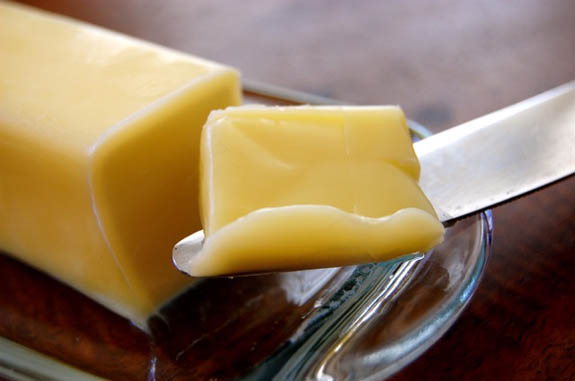
Where does butter come from?

Butter is made by churning the butterfat from milk.  Butter comes from milk.  Milk is full of tiny particles of butterfat.  Butter is made from this fat.

Cream is the part of milk that is richest in butterfat.  In butter factories, the cream is separated from the milk and pasteurized to destroy harmful bacteria.
Butter
The cream is then poured into tanks that look like big drums.  The drums turn and churn the cream.
While it is being churned, the cream “breaks” and the tiny drops of butterfat cluster together into lumps that become the butter we eat.
The milky liquid remaining after the cream has been churned to make butter is called “buttermilk.”
The lumps of butter are washed in water and then “worked” to make them smooth and uniform in taste and color.
Usually salt is added as seasoning and to make the butter keep better.  Finally, the butter is cut into blocks and packaged all ready for you to spread on your bread. – Dick Rogers

Tuesday, October 9, 2012

How is curling played?

Curling Game
Curling is a game played by sliding stones toward a target marked on the ice.  If you live in Canada or the northern United States, then you might see a curling game.

Curling is a winter sport similar to bowling or shuffleboard, but is played on frozen lakes or indoor ice rinks.
The game consists of sliding large, smooth stones toward a largest marked on the ice.
The game is played by two “rinks” (teams) of four players each.
Each player has two stones and takes turns curling against a player from the opposite team.  Curling players run ahead of then sliding stone with brooms and sweep the ice so that the stone will slide easily.
An “end” (inning) is completed when all the stones of both teams have been played.
The team placing the most stones nearest the center of the target wins the end.    Ten ends usually make a game.
Curling is believed to have started in Scotland in the early 1500s.  The game is enjoyed today in many countries in the world. – Dick Rogers

Friday, October 5, 2012

How did Canada get its name?


The name “Canada” may have come from an Indian word meaning “A group of huts.”

The origin of Canada’s name is not clear.  Some people think that the word “Canada” may have come from the Indian word “kanata,” meaning “a collection of huts or tents.”
Early in Canada’s history, French explorer Jacques Cartier sailed into the Saint Lawrence River and followed it far inland.  He was stopped by swift rapids at what is now Montreal.
Unable to go farther, he asked the Indians he met what lay farther up the river, and they replied “Kanata.”
Cartier thought they meant the name of a country and called the new land “Canada” on his map.  Later it was discovered that “Kanata” meant just “a small group of huts.”
Another belief is that the name “Canada” came from still another Indian word meaning “welcome.”
Canada is the second-largest country in the world.  Only Russia covers more area than this great northern neighbor of the United States. – Dick Rogers

Wednesday, October 3, 2012

Why do we color Easter eggs?

Easter 
Since ancient times, eggs have been the symbol of the new life that returns to nature about Easter time.  We color Easter eggs and give them to our friends as a way of saying "spring is here."

On Easter Sunday, children in many places hunt colorful Easter eggs.  They are often told that the Easter eggs were brought and hidden by the Easter bunny.  This charming custom may have come from an old German folk tale.
But since ancient times, eggs have been used to stand for the new life that returns to nature about Easter time.
People would often dye eggs in spring colors and give them to their friends as gifts to celebrate the arrival of spring.
To many people, Easter still means the coming of spring, when the earth, too, “springs”  back to life with flowers and warm sunshine after a cold winter’s sleep.
We color Easter eggs and give them to our friends as a way of saying “spring is here!”
On Easter Sunday, Christians everywhere celebrate the resurrection of Christ.  Many people dress up in new spring clothes and go to church on this day. – Dick Rogers