Showing posts with label Sun. Show all posts

Sunday, October 25, 2015

Why do sunsets look red?

During the evening, when the sun is near the horizon we may see a beautiful sunset.  The reds and oranges of a sunset are caused by the filtering action of the sky.

Sunlight, as we know, is made of many colors.  We can see the colors that make up sunlight when we look at a rainbow.  As sunlight passes through the atmosphere, the different colors are scattered by the air.

During the day, when the sun is directly overhead, its rays do not have to travel through as much of the atmosphere to reach the earth.  The sunlight is scattered in such a way that we see more of the blue rays.  But at sunset, when the sun is low in the sky, the light rays must travel through much more of the earth’s atmosphere to reach the viewer.

As a result, the shorter blue rays are soon scattered out and we can see more of the longer orange and red rays of sunlight – and we have a reddish sunset.  The red color of sunrise is caused the same way. – Dick Rogers

Friday, September 18, 2015

What are stars made of?

Stars
Stars are formed from gigantic masses of hot glowing gases.  Hydrogen and helium are the most common gases in a star.  In the clearest night sky you might see a few thousand stars with unaided eye.  Every bright star is a sun, like our own sun.
Scientists tell us that a star is a huge glowing ball of hot gases.  It is a kind of gigantic atomic furnace in which the temperature at the center may be as high as several million degrees.  Hydrogen and helium are the most common gases found in a star.  Although they are made up of gases, their centers are so dense and hot that the atoms of gas are constantly colliding and fusing together into new materials.
As the atoms unite, some of their atomic energy is given off  in the form of heat and light which stream away from the star in all directions.  This is why stars shine.  Scientists can find out all this by using instruments called spectroscopes.  With these instruments they can tell from the light a star gives what the star is made of and how hot it is. – Dick Rogers

Tuesday, March 19, 2013

What makes the ring around the moon?


The ring around the moon or sun is caused when the rays of light are bent and reflected by clouds of ice crystals high in the sky.  A big, shining ring of light sometimes appears around the moon.  The ring is not really around the moon—it only seems to be:

The “ring around the moon” is caused when the moon shines on clouds of tiny ice crystals high in the sky.  The ice crystals bend and reflect the moonlight to make a halo, or circle of light.  Sometimes two bright spots, that look like a little moons, can be seen in the halo.  They are called “moon dogs.”  We can sometimes see a halo around the sun, and we can also see “sun  dogs,” as the sun shines through clouds of ice crystals.

Haloes are often seen in Arctic regions.  These colored rings are generally red on the inside, then orange, yellow and white on the outside.  When you see a ring around the moon or sun, it usually means that a storm is coming.  Smaller haloes sometimes appear around the moon of sun when light rays are bent and reflected by clouds of droplets.-Dick Rogers


Friday, November 16, 2012

What is the biggest desert?

Sahara Desert

The Sahara desert of North Africa is the Largest desert in the world.  It is nearly as big as the whole united states.

Almost as large as the whole United States, the Sahara stretches across the northern part of Africa from the Atlantic Ocean to the Red Sea.  

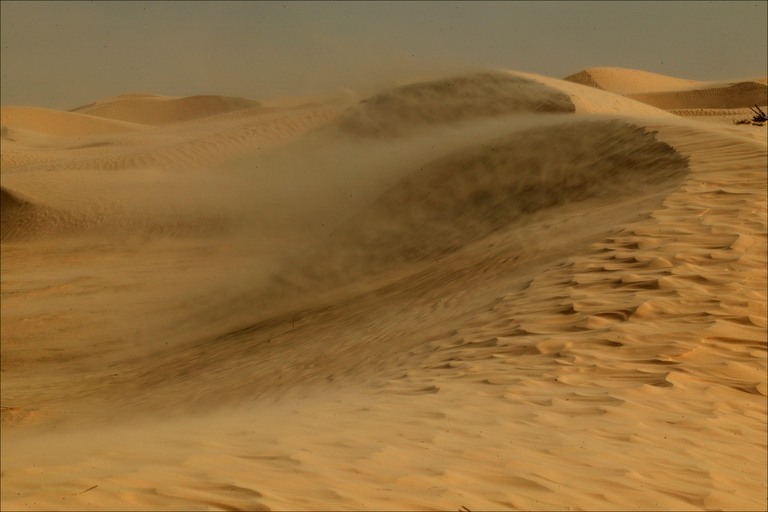
The Sahara desert is a vast, sun baked land of flat, rocky plains, shifting sands and rocky uplands.  A burning sun and scorching winds make it the hottest region in the world.  On summer days, the temperature may research 130 degrees F.  

Scattered through the Sahara there are oases, places where a spring or well provides enough water for date palms and other crops.  Only one river, the Nile, runs across the desert.  

The Sahara people wear long robes and turbans wound around the head and neck for protection against the hot sun and stinging sandstorms.  Camels were once the only means of transport across the Sahara.  Nowadays, buses and trucks cross many of the Sahara’s routes.–Dick Rogers

Tuesday, September 11, 2012

What makes the wind blow?

Wind Blow

Wind is caused chiefly by the uneven heating of the earth by the sun.  All winds, from gentle breezes that rustle leaves to raging hurricanes, are caused chiefly by the uneven heating of the earth by the sun.

When the air near the ground gets hot, it expands or swells.  This makes it lighter, and light air rises.
As it rises, cooler, heavier air flows in to take its place.  This movement of air makes a wind.
When the air moves slowly, we call it a breeze.  When it moves fast and strong, we may call it a gale or a hurricane.
If you live by the seashore, for instance, you may feel a cool sea breeze on a warm day.
During the day, the land becomes warmer than the sea and so does the air above it.  As the warmer, lighter land air rises, cool winds blow in from the sea to take its place.
All night the land cools more rapidly than the sea, and the breeze is reversed.  It blows out to sea.
What is true in your area is true on a larger scale of the big winds that blow over the earth.
A wind gets its name from the direction it comes from.  A north wind, for example, is one coming from the North blowing toward the South. – Dick Rogers

Friday, October 23, 2009

Let Your Little Light Shine (1 of 2)

Good morning everyone. I use to remember when I was still small, I love to play with my friends and we love to light a candle. We want to light it so that we will have a good light so that we can play well.

“One candle lights one candle, two candles light four . . . And where they shine, there is no darkness anymore.”

When we were little children, we would wish upon the first star we see at dust. We couldn’t help but get awed as tiny flickers in the infinite sky started to inhabit the cloudless dark space above us. As we grew older, we learned more about the celestial bodies residing in the universe—the Sun, the Moon, the planets, and the stars—yet the mysteries of the cosmos continue to baffle us ever to this day.

Even the experts called cosmologists are puzzled not only by the hugeness of the universe but also by the information that may just be lurking in the dark, or even lighted, areas of the immense outer space.

For many years, scientists believe that after the Big Bang, the universe will collapse with a “big crunch” due to the pull of gravity. It’s like pulling a rubber band in all directions, and the rubber band snaps back when the limit has been reached.

Recent scientific fingers, however, suggest that contrary to earlier belief—that the expansion of the universe slows down before it finally collapses—the universe is in fact expanding at a faster rate. In their quest for answers, scientists focused their attention to the stars and their environs.