Wednesday, January 30, 2013

How Did The Pilgrims Get Their Name?


The term “pilgrim” was used by William Bradford to describe the first Plymouth settlers.

A long time ago, people we now call the Pilgrims came to America and settled the first permanent colony of people from the Old World.

Pilgrim
They named their little New England village Plymouth in honor of Plymouth, England—the harbor from which they had sailed on the Mayflower in 1620.

The term “Pilgrim” may come from Gov. William Bradford’s early accounts of the Philgrims’ life.

He wrote that “they knew they were pilgrims” when they left their old homes, seeking freedom to follow their own religious beliefs and way of life in the New World.

But it wasn’t until two centuries after their arrival that these first settlers popularly became known in American history as the Pilgrims.

The Pilgrims knew themselves as the “Old Comers,” since they were the first to colonize the New World, while later generations referred to the Pilgrims as the “Forefathers.”–Dick Rogers

Monday, January 28, 2013

What Is The Meaning Of A 21-gun Salute?


Gun salutes are often used to mark special occasions.

Gun or cannon salutes sometimes honor distinguished persons or mark special occasions.  This custom began long ago, when guns and cannons were loaded by hand.

Upon the approach of a friendly ship, all the guns of the fort or ship were fired as a token of disarming them, for early guns could not be speedily reloaded.

Modern salutes are fired with blank charges.
21 Gun Salute

The number of shots is determined by the rank of the person being honored.  A 21-gun salute is fired for heads of governments, member of a royal family and others of similar rank.

19 guns are fired for officers above the rank of admiral or general, state governors and ambassadors.

Salutes of 17, 15, 13, 11, 7 and 5 guns are fired for lesser ranks.  Firing an odd number of shots is believed to come from an old naval superstition that an even number of shots is unlucky or causes misfortune.–Dick Rogers

Saturday, January 26, 2013

What Is Patent?


Patent
A patent is a government grant which gives an inventor, and no one else, the right to make and sell his invention for a certain number of years.

Perhaps you have seen the words “Patent Pending,” “Patent Applied For,” or “Patent No. 123456,” for example, marked on many of the things you buy and use.
These are patent signs that tell us that the inventor of the product, and no one else, has the right to make and sell his invention without paying to do so.

Patents are granted and protected by the government for a certain number of years.
The inventor who wants to patent a new invention must submit a description of it to the Patent Office.

He must also claim that the invention is his own idea as well as pay an application fee.

If the idea is judged to be brand new and useful, the Patent Office issues a patent.

Just at patents protect inventors, copyright protect the literary, musical, and artistic works of authors, composers, and artists from those who would copy their work or claim to have created it.–Dick Rogers

Thursday, January 24, 2013

Where does mercury come from?

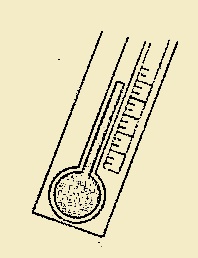
Mercury

Mercury is usually found in rust-colored rocks called cinnabar.  The ore is crushed, then heated to release the mercury.

Mercury is perhaps the strangest of all metals.  It is the only metal that liquid at ordinary temperatures.

In nature, mercury is most often found in rust-colored rocks called cinnabar, although pure mercury can be mined.

To get the mercury from its ore, the cinnabar is crushed then heated to release and vaporize the mercury.  The mercury vapor then is caught and cooled.

Cooled, the vapors condense into a silvery liquid such as you see going up and down in a thermometer.

Because of its fluid quality and color, mercury is sometimes called “quicksilver.”  Anyone who has ever tried to pick up some spilled quicksilver will agree that the name is a good one.

When spilled, it  “breaks” into tiny balls that are hard to gather up.

Today, mercury’s unusual properties make it useful not only in thermometers, but in making thousands of products – from barometers and lights switches to pesticides. – Dick Rogers

Tuesday, January 22, 2013

Why Does a Firemen's Helmet Have A Big Brim?


Firemen's Helmet
The big brim is designed to shed water so it won’t run down the fireman’s neck when he’s fighting a fire.

Nothing causes quite so much excitement in our everyday lives as the wall of a fire-engine siren.  It screams a warning to people to get out of the way of a fire truck as it roars through the streets on its way to a fire.

A fireman works around lots of water when he’s fighting a fire.  He wears a large, sturdy helmet to protect his head from falling debris and to keep from being drenched by water spray.

The broad brim on his helmet turns up on the sides and down at the back.  It catches the water.

Then, the water runs down and off the big brim to the rear, instead of down the fireman’s neck.

On each helmet is a shield with the fireman’s number.  A fireman also wears a heavy canvas or rubber coat and thick rubber boots.  His coat and boots help keep him from getting cold and wet but they do more than this.

They help project him from burning embers and other hazards, too. – Dick Rogers

Sunday, January 20, 2013

How Does A foghorn Work?


Foghorn
The greatest diaphone foghorns are worked by blasts of air.

When log closes in, the foghorns begin.  They warn ships of dangerous rocks and shoals.  Perhaps the most familiar kind of foghorn, is the deep, horse bellow of the foghorn called it “diaphone.”

Diaphone foghorns are worked by blasts of air, and often sound two-toned blasts.  First high, then low, then loud “BUUUOOOoooo” can be heard up to nine miles away.

Electric foghorns work much like a horn does on a car.  They make low, honking sounds.

Still others produce siren, whistle and chime signals.  The motion of the waves rock the bell buoy back and forth to make the bell ring.

The different kinds of fog signals help us to tell them apart.  Each lighthouse or fog signal station is known by the sound and number of its blasts and by the silences in between.  Some foghorns operate automatically, switching on and off during bad weather. – Dick Rogers

Friday, January 18, 2013

How Is Lumber Made?

Lumber

The chair you are sitting on was perhaps once part of a tree that grew in a forest.

Lumber, as we know, is the wood of trees that has been sawed into planks, boards, etc.

Before tree can be sawed into lumber, it must be cut down and transported to the sawmill.

The logs are sent through the sawmill on a moving belt.  When a log first enters the sawmill, jets of water give it a stinging bath to remove the sand and dirt that might dull the teeth of the saw.

After washing, the log is then rolled onto a carriage that carries it into the teeth of the head saw that saws it into rough boards.

When the log has been reduced to boards, the boards travel to other saws that trim off the rough edges and cut them to the right length.

Then they are sorted and planed smooth.  Finally, the lumber must be seasoned, or dried, so the woods will not warp or rot. – Dick Rogers