Showing posts with label Vapor. Show all posts

Saturday, February 9, 2013

Where Camphor Come From?

Camphor

Natural camphor is a fragrant gum that comes from the camphor tree.

Camphor (pronounced KAM-fur) is a fragrant gum that comes from the camphor laurel tree.

Camphor is used in medicine, explosives, and plastics, as well as in many other useful products.  (Perhaps your mother uses balls of camphor in closers and drawers to keep moths away.)

Most camphor trees grow in Japan and on the island of Formosa.  The trees grow tall and have small white flowers and shiny, green, leathery leaves that smell like camphor when crushed.

The camphor is obtained by chopping the wood of the trees and steaming the chips.

The camphor comes off as a vapor that condenses into crystals, which are then purified into gum camphor.

The oil left after the camphor has been taken out is known as camphor oil, which is used in scenting soap.

Chemists have learned to make artificial camphor that is practically identical with camphor from the camphor trees.–Dick Rogers

Thursday, January 24, 2013

Where does mercury come from?

Mercury

Mercury is usually found in rust-colored rocks called cinnabar.  The ore is crushed, then heated to release the mercury.

Mercury is perhaps the strangest of all metals.  It is the only metal that liquid at ordinary temperatures.

In nature, mercury is most often found in rust-colored rocks called cinnabar, although pure mercury can be mined.

To get the mercury from its ore, the cinnabar is crushed then heated to release and vaporize the mercury.  The mercury vapor then is caught and cooled.

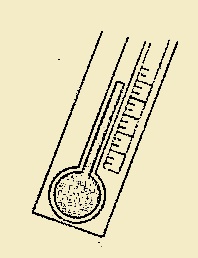
Cooled, the vapors condense into a silvery liquid such as you see going up and down in a thermometer.

Because of its fluid quality and color, mercury is sometimes called “quicksilver.”  Anyone who has ever tried to pick up some spilled quicksilver will agree that the name is a good one.

When spilled, it  “breaks” into tiny balls that are hard to gather up.

Today, mercury’s unusual properties make it useful not only in thermometers, but in making thousands of products – from barometers and lights switches to pesticides. – Dick Rogers