Showing posts with label Sahara Desert. Show all posts

Thursday, September 3, 2015

Why Is A Desert Dry?

Deserts cover nearly a fifth of the earth’s surface.  We would probably describe a desert as a hot, barren land where it hardly ever rains—a land so dry that few plants can grow on it, and where other
Dry Desert
forms of life also find it difficult to exits.  The desert we have just described occupies nearly a fifth of the earth’s land surface.  Large deserts can be found in all of the continents except Europe.
The driest and hottest deserts are found in the trade wind zones north and south of the Equator.  Deserts in these areas, such as the Sahara Desert of North Africa, are dry even though they may be near the ocean waters.  Here the winds blow across the desert toward the Equator and become very hot and dry, and release little of their moisture as rain.
Some deserts are dry because they are so far from the sea that the winds blowing in from the ocean lose their moisture long before they reach these deserts.  And in many cases, desert regions are cut off from the moisture laden sea air by tall mountains that catch the rainfall on their seaward side. – Dick Rogers

Friday, November 16, 2012

What is the biggest desert?

Sahara Desert

The Sahara desert of North Africa is the Largest desert in the world.  It is nearly as big as the whole united states.

Almost as large as the whole United States, the Sahara stretches across the northern part of Africa from the Atlantic Ocean to the Red Sea.  

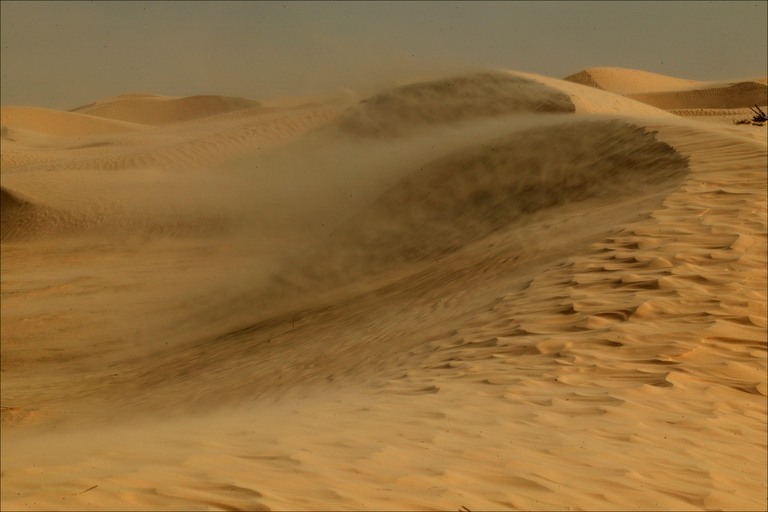
The Sahara desert is a vast, sun baked land of flat, rocky plains, shifting sands and rocky uplands.  A burning sun and scorching winds make it the hottest region in the world.  On summer days, the temperature may research 130 degrees F.  

Scattered through the Sahara there are oases, places where a spring or well provides enough water for date palms and other crops.  Only one river, the Nile, runs across the desert.  

The Sahara people wear long robes and turbans wound around the head and neck for protection against the hot sun and stinging sandstorms.  Camels were once the only means of transport across the Sahara.  Nowadays, buses and trucks cross many of the Sahara’s routes.–Dick Rogers